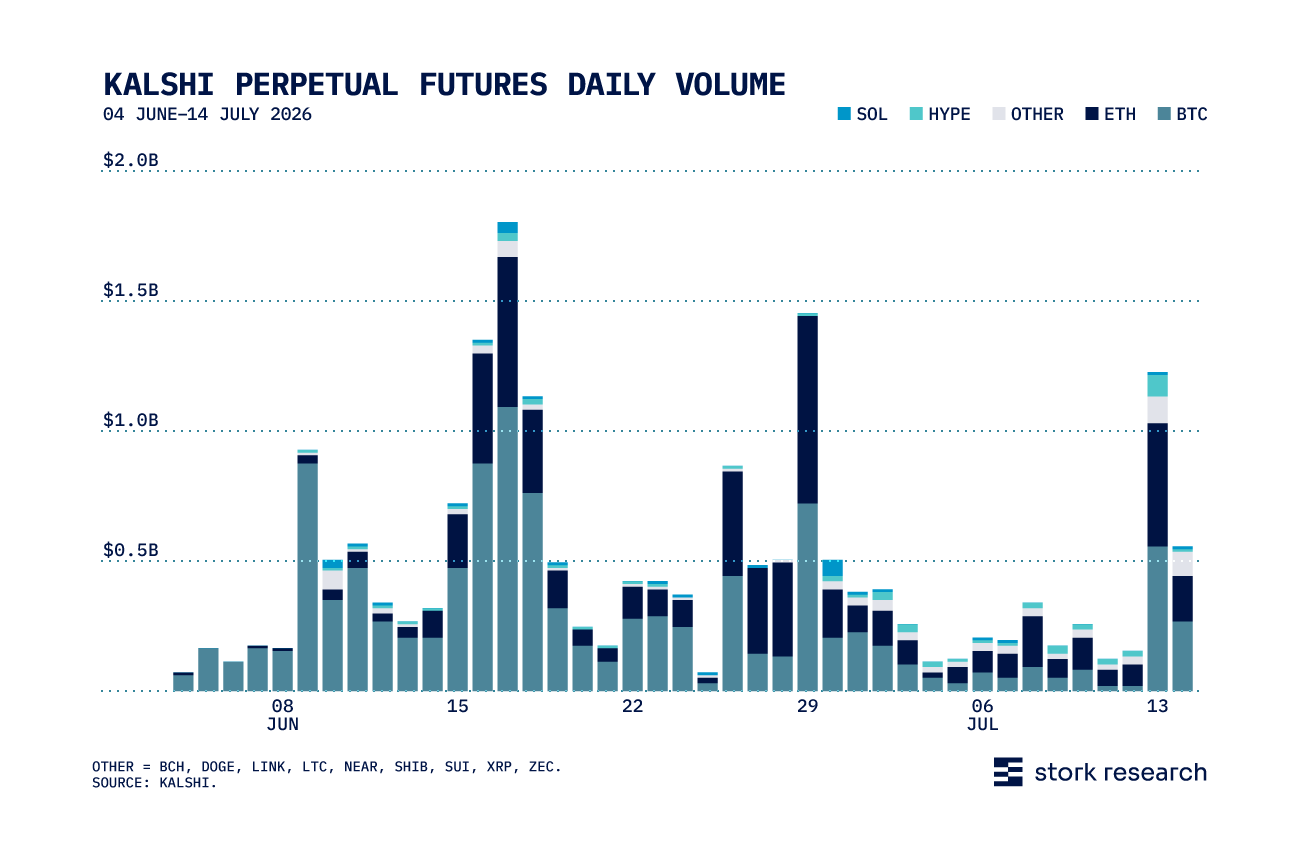
US regulators threw the doors open for US perpetual futures exchanges in May, granting Kalshi a license to offer these derivatives, known as “perps.”
US perpetual futures trading volume got off to a slow start, but it seems to have found its footing. More exchanges are operating, including Robinhood, which recently entered the US market via its subsidiary, Bitstamp. The US perpetual futures market now includes a mixture of fully onshore operators like Kalshi, Luxembourg-based Bitstamp, and offshore venues like Coinbase-owned Deribit that have opened trading to some US investors.
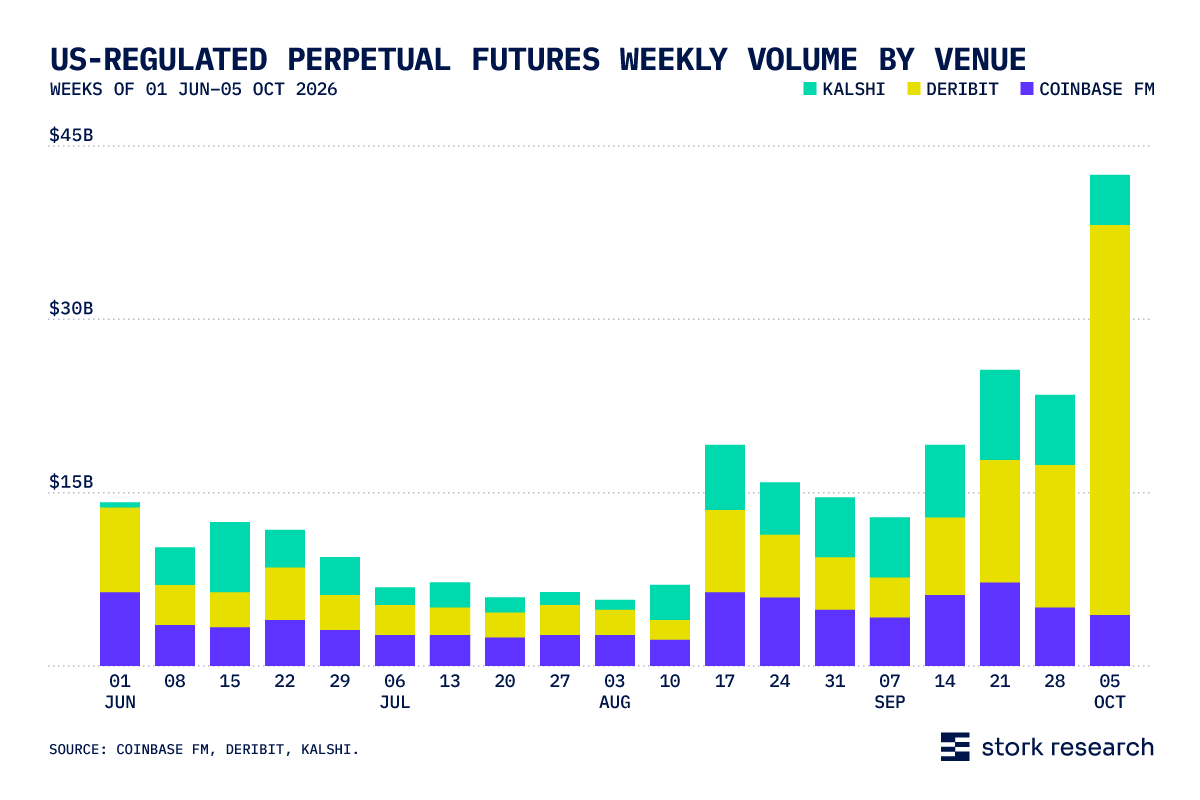
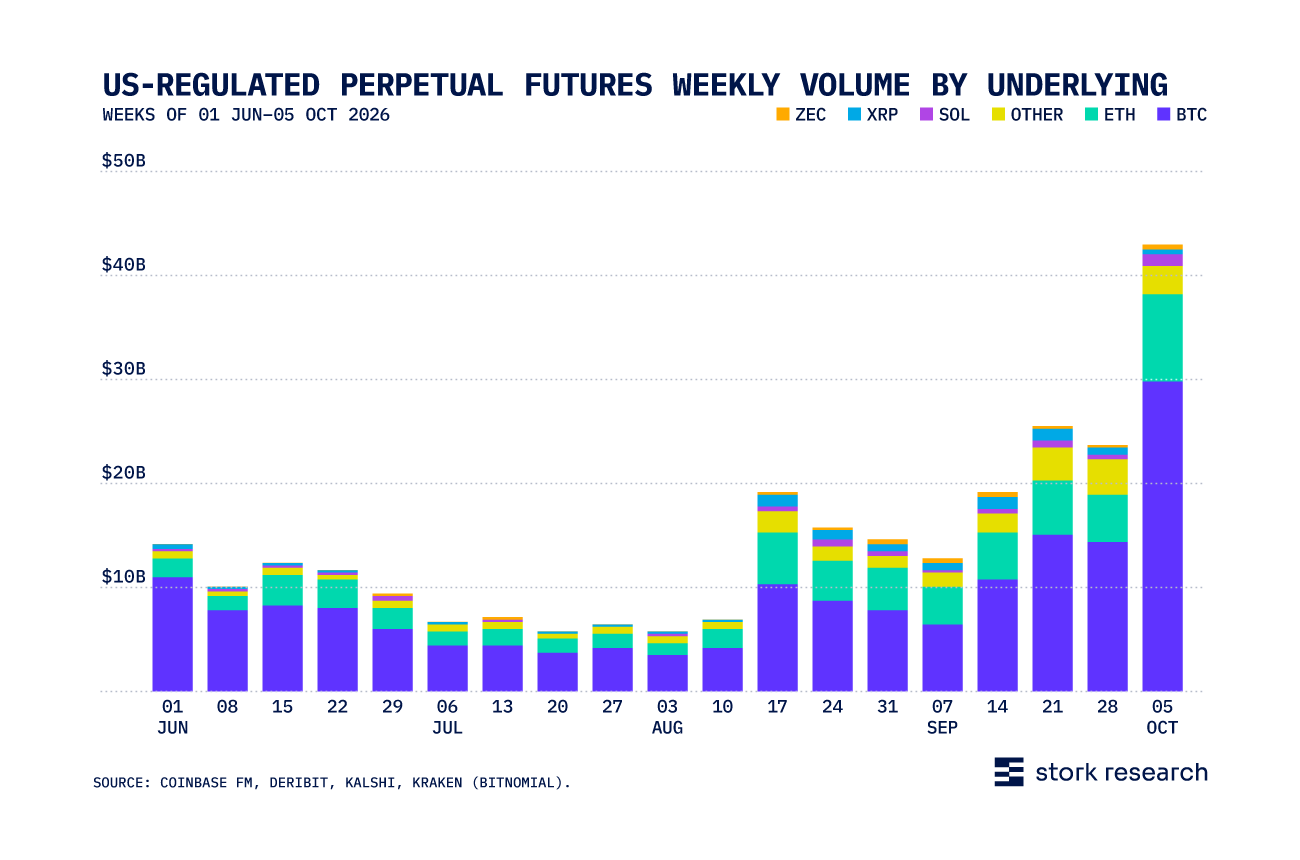
Deribit drove the largest share of volume growth on this chart, rising suddenly from $12.4B in the week of Sep 28, to $33.8B in the week beginning Oct 5. For Deribit, it was the third week in a row of record-setting volume among perps venues that are newly accessible under US regulatory oversight. Deribit is a wholly owned subsidiary of Coinbase, with its own headquarters in Dubai. A CFTC no-action letter in late May let Coinbase source some US-based customers to Deribit and Coinbase Financial Markets (Coinbase FM).
Kalshi is based onshore, with headquarters in New York. Kraken-owned Bitnomial, based in Chicago, has reported $2.03B in 30D volume on perps markets, as of today. It's not included in this chart due to scale.
Meanwhile, Robinhood is rolling out US perpetual futures via EU-based Bitstamp, having completed an acquisition in June, 2025. According to some reports, a limited roll-out has begun. Stork Research data shows Bitstamp cleared $630M in perps, the week of September 28, the same week Robinhood announced its US perpetual futures. It was Bitstamp’s largest week in perps since at least June 1. It’s not clear how much of the volume, if any, was with US traders.
Bitcoin perps remain the largest by volume across these exchanges, with 62.4% of the cumulative volume to date. Ether perps have traded 21.9% of the total volume; XRP perps are 3.0%; Solana, 2.5%, and Zcash 1.5%.
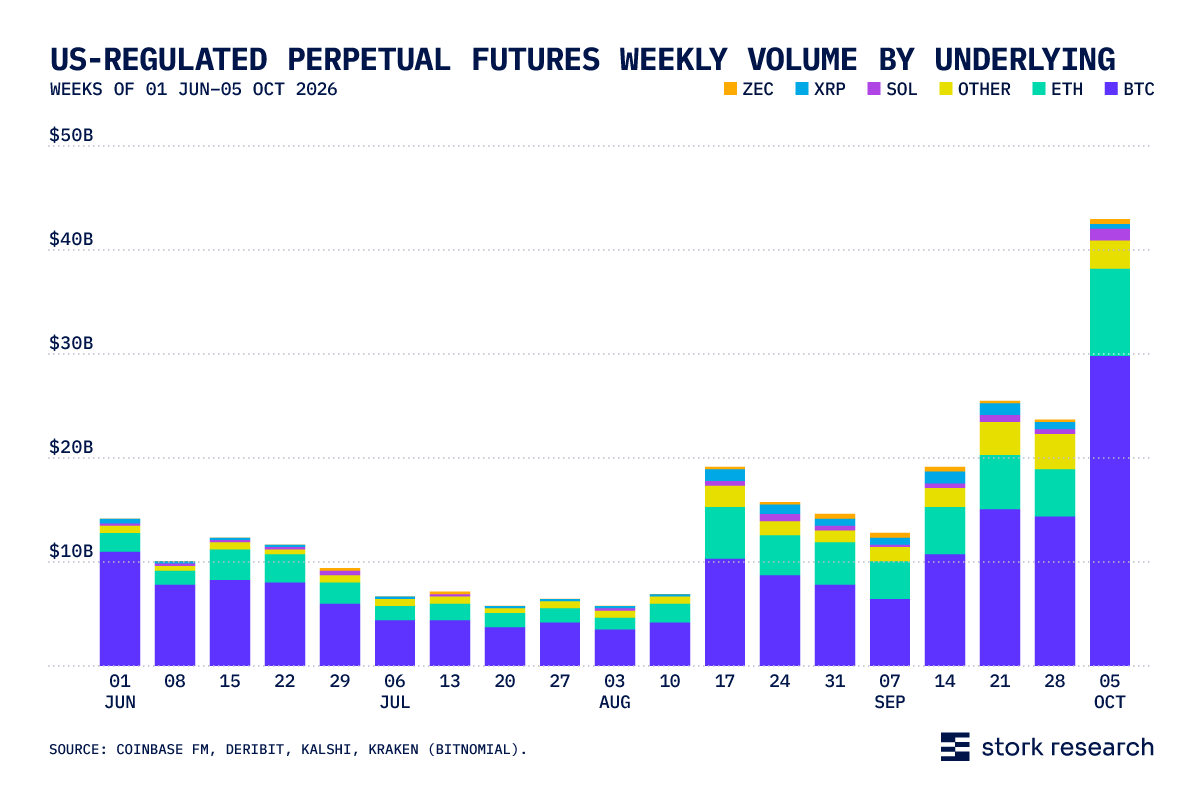
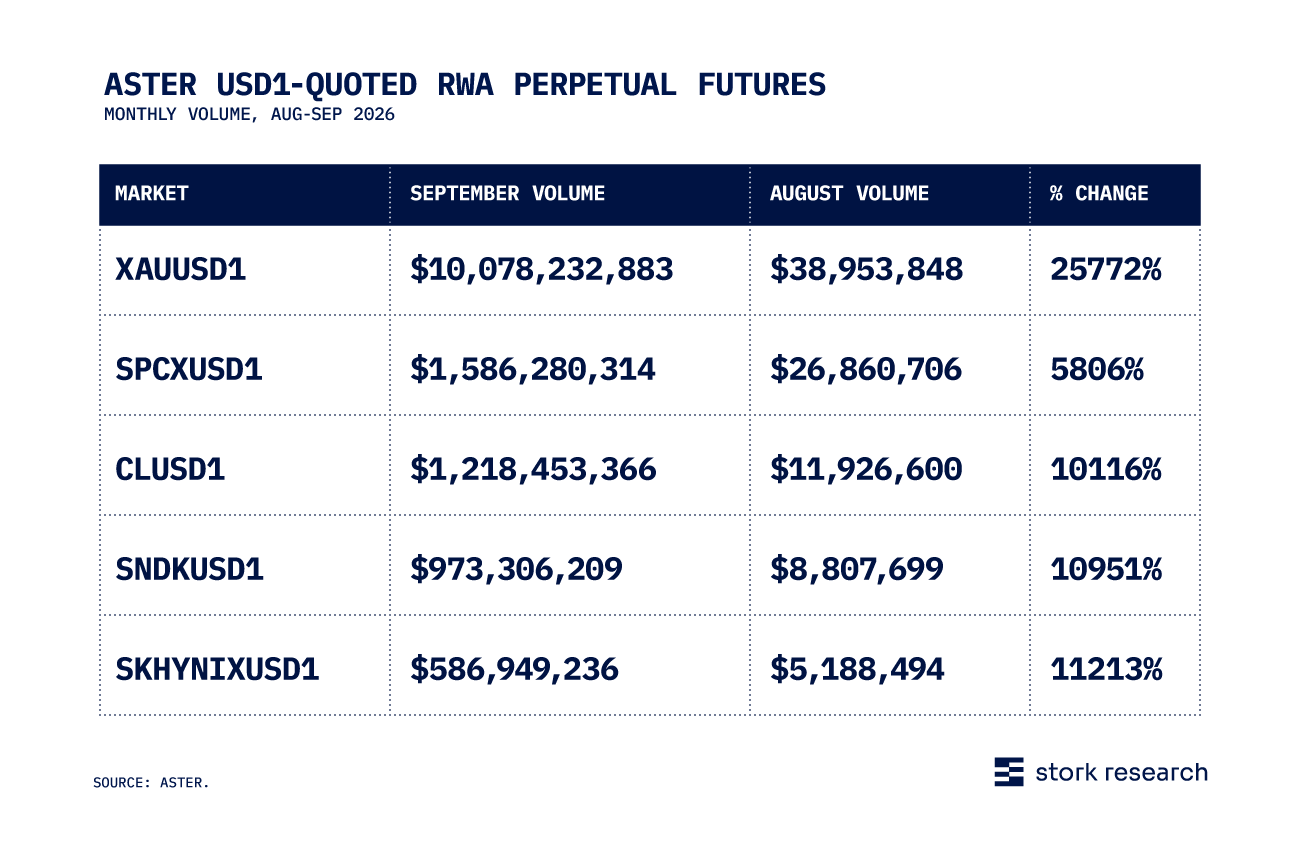
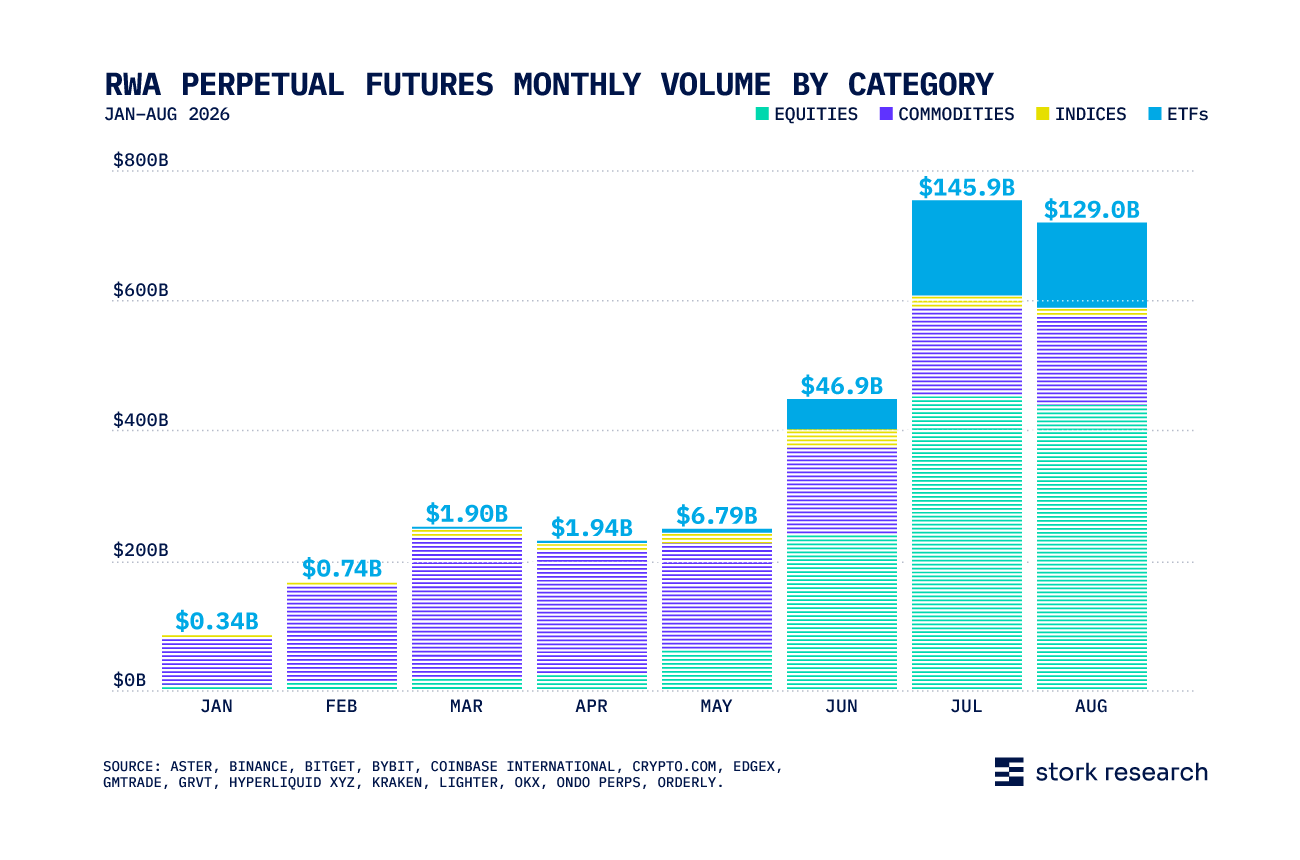
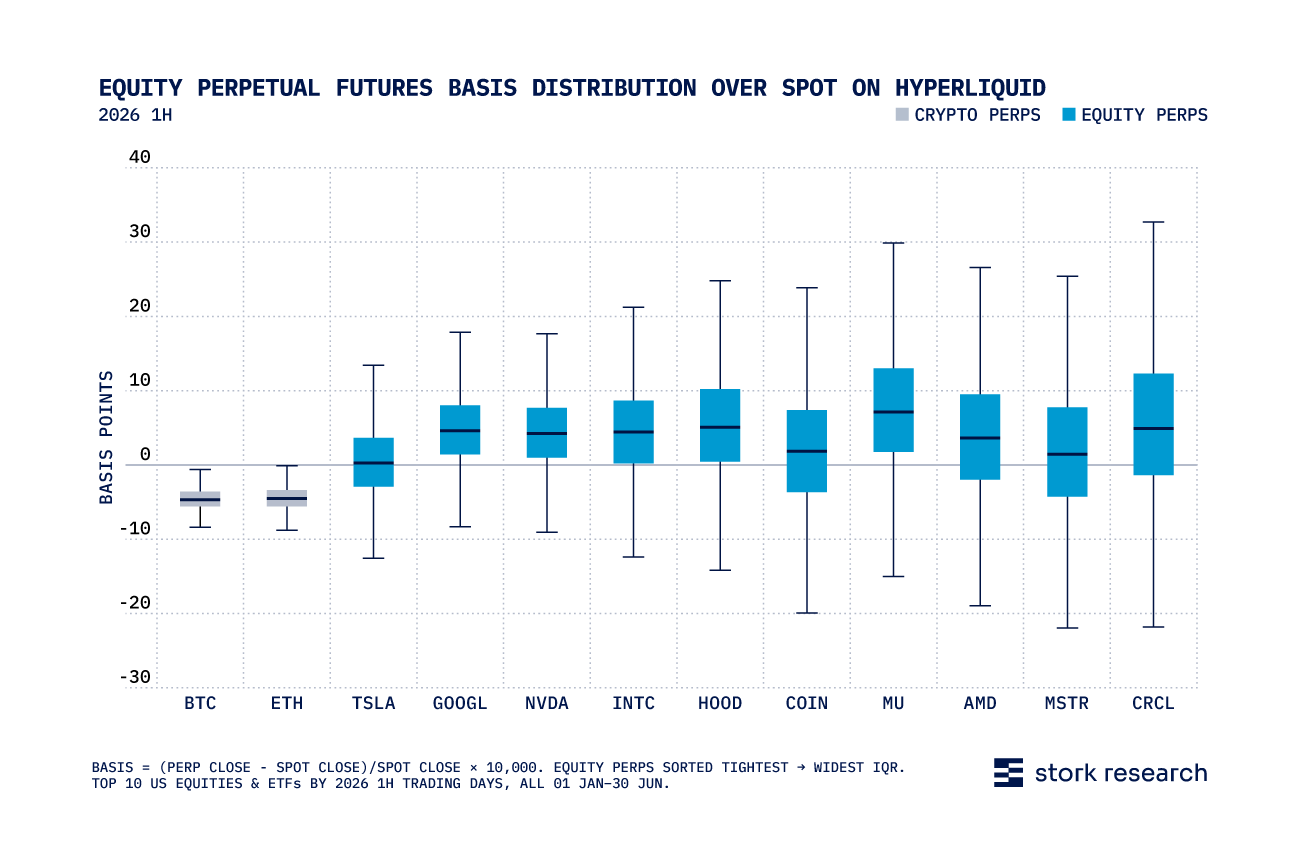
“Other” on this chart includes US perpetual futures on real-world-assets (RWAs). Left off the CFTC’s initial approvals, exchanges are in various stages of approval and launch of perps contracts on non-crypto assets like commodities and equities. These markets have only just crested $1 billion in weekly volume altogether, small relative to US crypto perps and relative to the offshore and onchain RWA perps volume, which was nearly $600B in September.
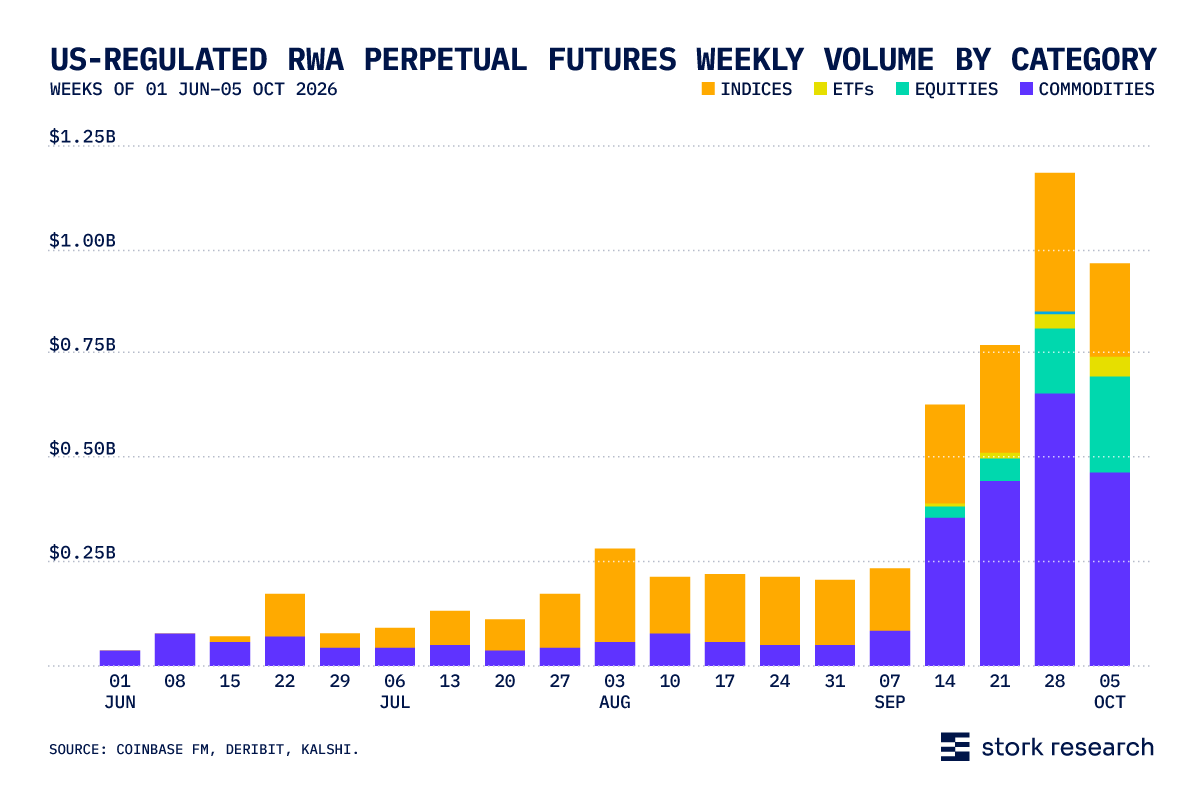
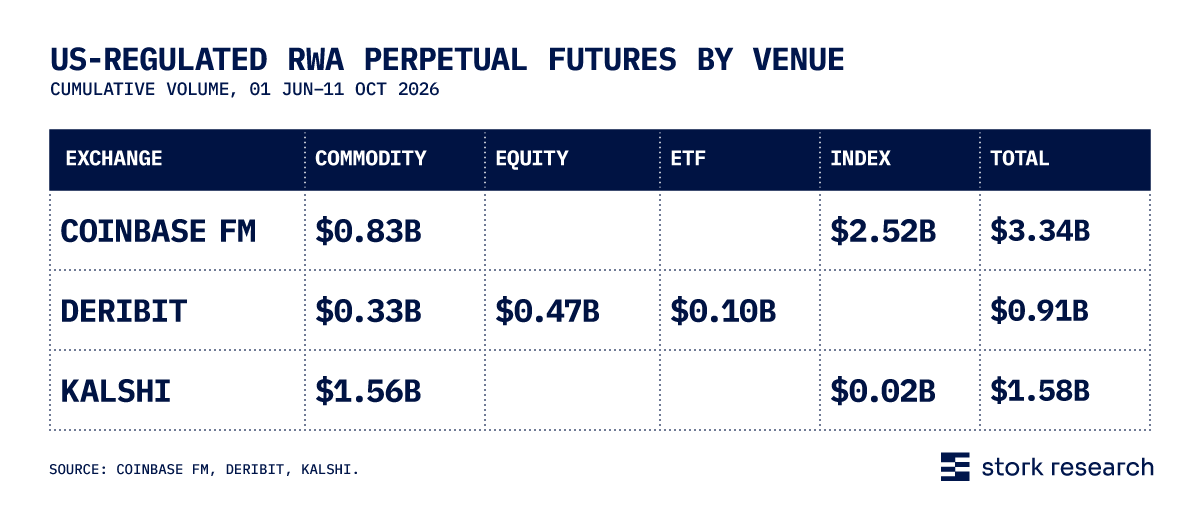
New offerings are coming up quickly: Kalshi launched gold and silver perps last month, following CFTC approval. Trading there has already reached $1.56 billion in volume, rivaling longer-running perpetual-style derivatives on Coinbase. Coinbase Financial Markets offers long-dated derivatives that duplicate some of the features of perpetual futures, including contracts on Pax Gold, a tokenized gold instrument, and four proprietary indices, launched in May. Of the indices, a Nasdaq 100 proxy has most of the volume—$1.7B cumulative. The other three track AI, defense, and Chinese stocks.
US perpetual futures, perp-adjacent contracts, and offshore perps markets that are accessible to some US investors, are showing their first strong signs of growth.
Meanwhile, the largest perpetual futures exchange operators, all offshore and onchain, are circling the US market. Binance’s US subsidiary is reportedly applying for approval to operate prediction markets in the US. OKX has partnered with NYSE owner ICE to offer oil perps in some jurisdictions (not US). And rumors continue to circulate that Hyperliquid is pursuing a US regulatory approval.
Will US demand signals be strong enough to drive investment from the largest perpetual futures operators? Perhaps more importantly, can new and expanding operators grow fast enough to become entrenched in financial markets, ahead of US potential political and regulatory changes to come?