


To understand why Stork's performance profile matters to Lighter, it helps to understand how Lighter is built.
Lighter operates as a zero-knowledge (ZK) rollup on Ethereum, running a central limit order book (CLOB) with custom ZK circuits that cryptographically prove the correctness of every order match and every liquidation. Unlike automated market makers that rely on algorithmic pricing, Lighter's order book matches trades by price-time priority, the same model used by institutional trading venues. This enables tighter spreads, more efficient capital utilization, and a trading experience comparable to a centralized exchange.
The ZK proof layer means that all exchange operations (matching, liquidation, margin calculation) are publicly verifiable on Ethereum. That is a strong guarantee, but it also raises the bar significantly for the oracle feeding price data into the system. If the oracle price feed has high latency, the mark prices the DEX uses for margin and liquidation calculations become stale. If the oracle goes down, trading on the DEX halts. If the oracle is manipulable, the integrity of the entire trading system is at risk.
Lighter needed a perp DEX oracle that could match its own performance standards. Stork's millisecond latency, decentralized publisher network, and cryptographically signed price feeds were the right fit.
One of Lighter's defining claims is that every match and every liquidation is cryptographically verifiable on-chain. Stork is what makes that promise possible at the oracle layer.
Stork is designed around verifiability from the ground up. Publishers (independent data providers) sign their price attestations using ECDSA signatures with secp256k1 keypairs, the same elliptic curve cryptography used by Ethereum. When Stork's aggregator receives and combines publisher data, it signs the aggregated result before delivering it downstream. Those signatures can then be published in Stork's on-chain contracts, allowing anyone to confirm that the data came from the correct publishers, was aggregated by a legitimate Stork aggregator, and used the declared aggregation method.
When Lighter's risk engine evaluates a position for liquidation, it is working from price data that carries this chain of cryptographic proof. Each number is a verifiable attestation, traceable back through the aggregation layer to the underlying publishers. In a perp DEX delivering the kind of verification guarantee Lighter delivers, an oracle that produces signed, verifiable data is key.
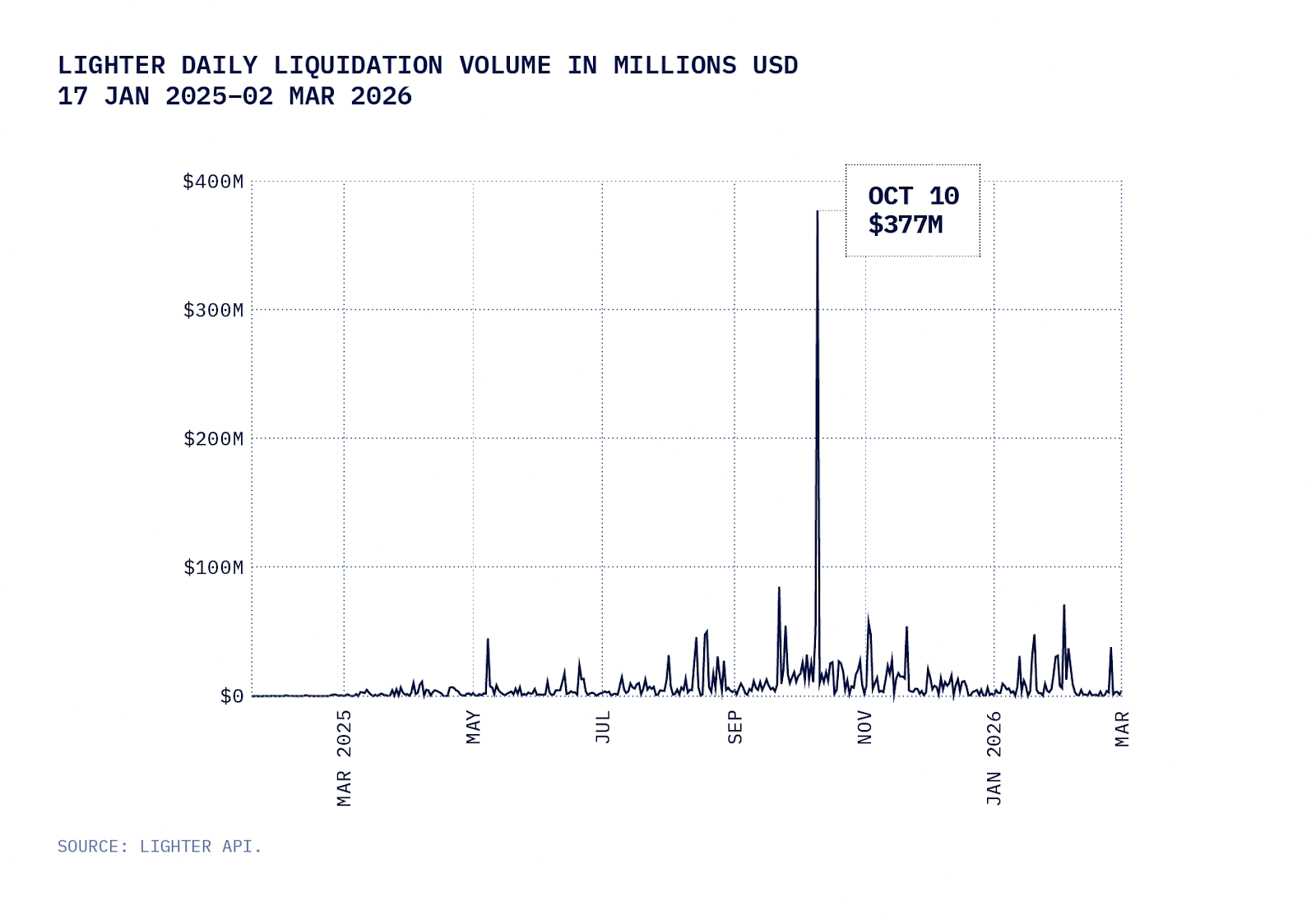
Stork's uptime record with Lighter has been consistent across the exchange's most volatile periods. The liquidation volume data from Lighter's API tells the story in numbers: single-day events exceeding $85 million and $377 million in liquidations represent moments of extreme market stress, exactly when oracle downtime would be costly to a DEX. Stork has maintained its feeds through those events.
Stork's aggregator architecture is designed to be redundant and horizontally scalable. Because aggregation responsibility can be distributed across multiple aggregators, the system does not have single points of failure, and latency does not degrade as the number of assets or update frequency increases. For an exchange like Lighter, where throughput is measured in tens of thousands of operations per second, that scalability is a direct operational requirement.
Lighter is one of the fastest-growing perpetuals exchanges in DeFi, processing billions in monthly volume across crypto, metals, and equity markets on a zero-knowledge Ethereum L2. From the very beginning, a DEX-oracle partnership between Stork and Lighter has been integral to its success.
The relationship has grown alongside the exchange itself, with Stork supporting every market Lighter has listed, every asset class it has expanded into, and every scaling milestone it has reached.
That longevity matters. A blockchain oracle is critical infrastructure that must perform under the most volatile conditions in financial markets, at the precise moment an exchange most needs it. Stork has been that infrastructure for Lighter from launch through the platform's rapid growth.
Related: Read Stork Labs' Research outlining a framework for analyzing blockchain oracle risk and composability, and learn where perps are on that spectrum.
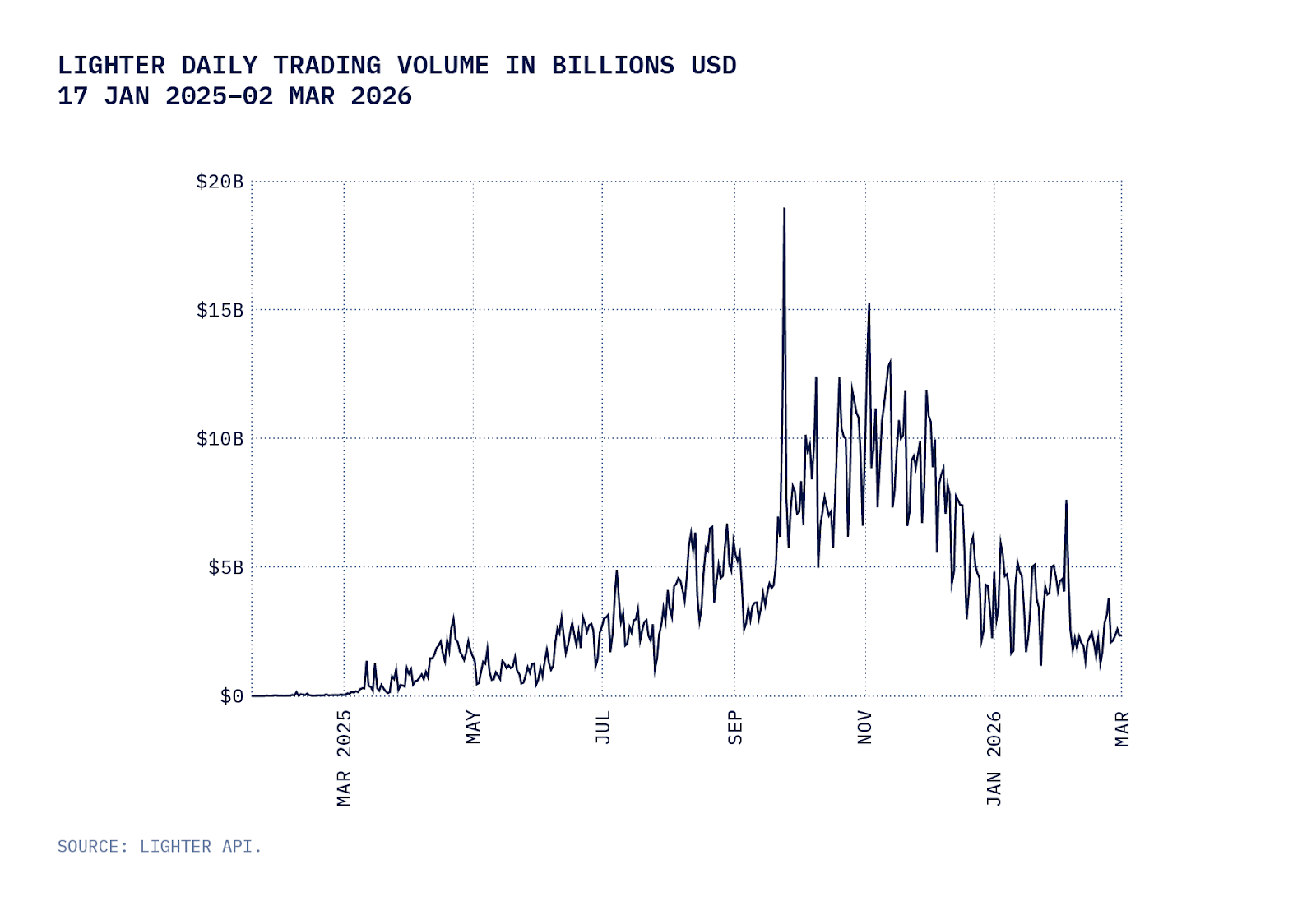
Lighter has scaled dramatically since its January 2025 launch, quickly establishing itself as a serious contender in the decentralized perpetuals market and growing into a platform handling billions in monthly volume.
Much of that growth has been driven by Lighter's expansion across asset classes. The exchange launched with major crypto pairs and has since added a broad and diverse set of markets. The table below shows Lighter's top markets by open interest.
Source: CoinGecko.
What stands out immediately is the emergence of metals. XAU_USDC (gold) and XAG_USDC (silver) rank sixth and eighth by open interest, representing over $34 million in combined OI. That reflects the rising demand for RWA perps, including commodity perps, as traders seek exposure to traditional macro assets in a 24/7, permissionless venue. Stork's oracle infrastructure supports gold and silver price feeds with the same low latency it delivers for crypto, enabling Lighter to offer genuinely competitive metals markets.
Lighter's approach to its own token generation event was characteristically low-key. Rather than building a marketing spectacle around the LIT launch, the team focused on execution. On December 30, Stork moved quickly to get a LIT price feed live in time to support trading. At that moment, LIT had limited data sources, but because LIT was trading on Lighter, one of the most liquid DEXs on-chain, Stork was able to construct a reliable oracle feed and deliver it on time.
This kind of responsiveness and flexibility on new listings is a signature of Stork's approach. Price feeds for new assets are online when users need them most, at the moment of launch. This is enabled not just by team hustle, but by a modular architecture that allows rapid adaptation. The LIT episode is a clear example of the flexibility and execution speed that defines how Stork operates alongside its partners.
Read another Stork case study to learn about a fast time to market in a perp DEX-oracle growth partnership.
The trajectory of Lighter's market mix points toward the next phase of DeFi growth. Equity perps and commodity perps are gaining traction as traders recognize the structural advantage of 24/7 decentralized markets for assets that only trade on regulated venues during business hours. Gold and silver don't stop moving on weekends because the London Metal Exchange is closed, but traditional derivatives markets do. RWA perps on Lighter fill that gap.
The current geopolitical environment is accelerating this trend. Lighter's $34M+ in gold and silver OI is an early signal of where this is heading. As the market for RWA perps matures, the oracle requirements become more demanding: Stork must deliver accurate, low-latency pricing for assets with complex underlying market structure, across weekends and holidays, without degradation.
Lighter has raised two rounds from top-tier venture firms Craft, Dragonfly, Founders Fund, Haun, Ribbit Capital and Robot Ventures. Robinhood's recentstrategic investment in Lighter underscores the seriousness with which traditional finance is approaching the DEX space. As Lighter moves further into institutional territory with broader asset coverage, deeper liquidity, tighter integration with traditional finance, the oracle infrastructure underpinning its operations becomes even more critical. Stork's architecture was built for exactly this environment: low latency, cryptographic verifiability, and the ability to add new feeds rapidly as Lighter expands.


