Lines are blurring at the cutting edge of global markets. Until now, cryptocurrency markets have existed in their own bubble, as it were: defined by different hours, different venues and often different participants, they have functioned separately from equities markets.
Equity perpetual futures contracts, also known as equity perps, are breaking down these distinctions, creating what will be a major new component in global, 24/7 price discovery for US equities.
By applying the mechanics of the crypto-native perpetual futures contract to US stocks, crypto-native derivatives trading platforms are offering something traditional brokerages cannot: uninterrupted, leveraged access to the world’s most liquid equities. But as this asset class moves from the fringes to the center of the trading desk, understanding the unique market microstructure risks is no longer optional; it is a prerequisite for survival.
This article offers a brief introduction to equity perps: what they are and how they work, including the mechanics of price feeds (aka blockchain oracles) that make them possible. It provides traders and firms with a brief introduction to some of the specific risks involved in trading equity perps, including counterparty risk, thin markets and market status transitions. Nothing here should be considered financial advice. To learn more about Stork's equity feeds for perps markets and other use cases, get in touch with us.
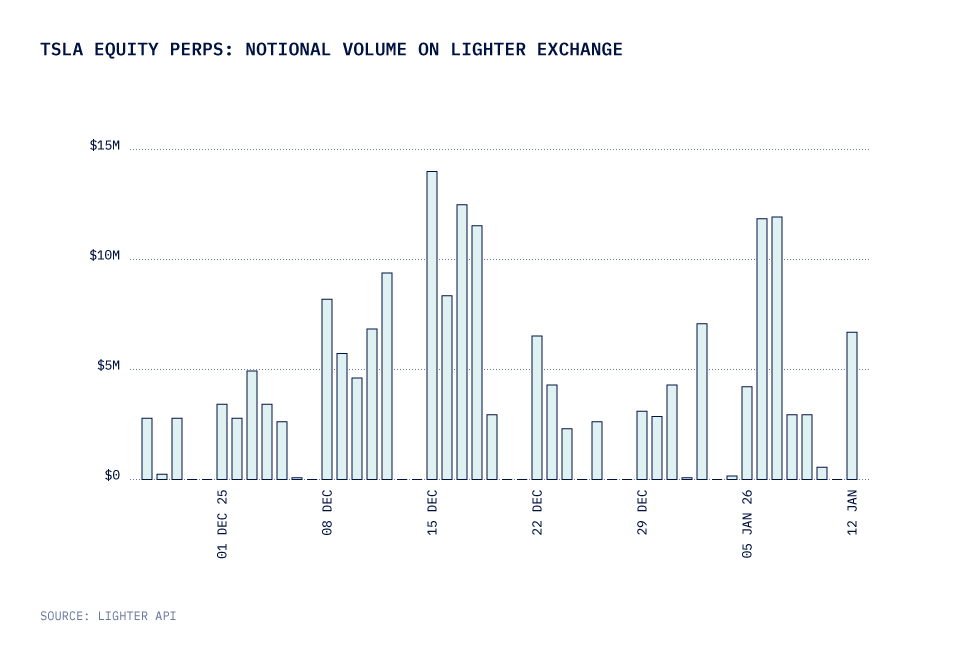
An equity perp is a synthetic derivative that tracks the price of an underlying stock, without an expiration date. Unlike traditional futures, which require traders to "roll" their positions every quarter, equity perps can be held indefinitely. Like traditional futures, they offer leverage, but at much higher multiples (sometimes up to 100X) on underlying value.
The price is kept in line with the actual stock market through a "funding rate" mechanism. If the perp price is higher than the spot price, long positions pay a fee to shorts; if it is lower, shorts pay longs. As BitMEX explains (this crypto derivatives exchange invented the perpetual futures contract in 2016 with bitcoin as the underlying) equity perps essentially crypto-ify the stock market, allowing for high leverage and 24/7 trading availability.
Equity perps are one facet of RWAfi, also known as RWA finance, in which tokenized real-world assets (RWAs) are integrated into onchain finance protocols for lending and trading. Oracles deliver verifiable price feeds, making RWAs composable into DeFi environments. Equity perps are part of a broader category of RWA perps that includes perpetual futures on commodities like gold, silver and copper.
How Equity Perps Are Transforming Global Trading
One driver behind the rise of equity perps is the "follow the sun" nature of retail demand. In regions like East Asia and India, the appetite for US tech stocks is massive, yet traditional market hours (9:30 AM to 4:00 PM ET) are inconvenient. TD Securities noted in a recent article, "As trading begins to follow the sun, it is easy to imagine global retail investors turning to perps tied to well-known US large-cap stocks."
For the professional trader, equity perps offer more than just convenience. They unlock:
Market operators are positioning to meet this demand: Lighter, one of the two largest onchain perpetuals futures markets (aka perp DEXs), recently announced the launch of 24/5 equity perps, powered by Stork. BitMEX has also announced an offering. (Read more in this case study on Lighter & Stork's DEX-Oracle partnership.)
Regulators, too, are taking notice: both the CFTC and the SEC are considering rulemaking, and SEC Chair Paul Atkins has made comments in favor of integrating perps into US securities markets, as TD Securities noted in their recent article, linked above.
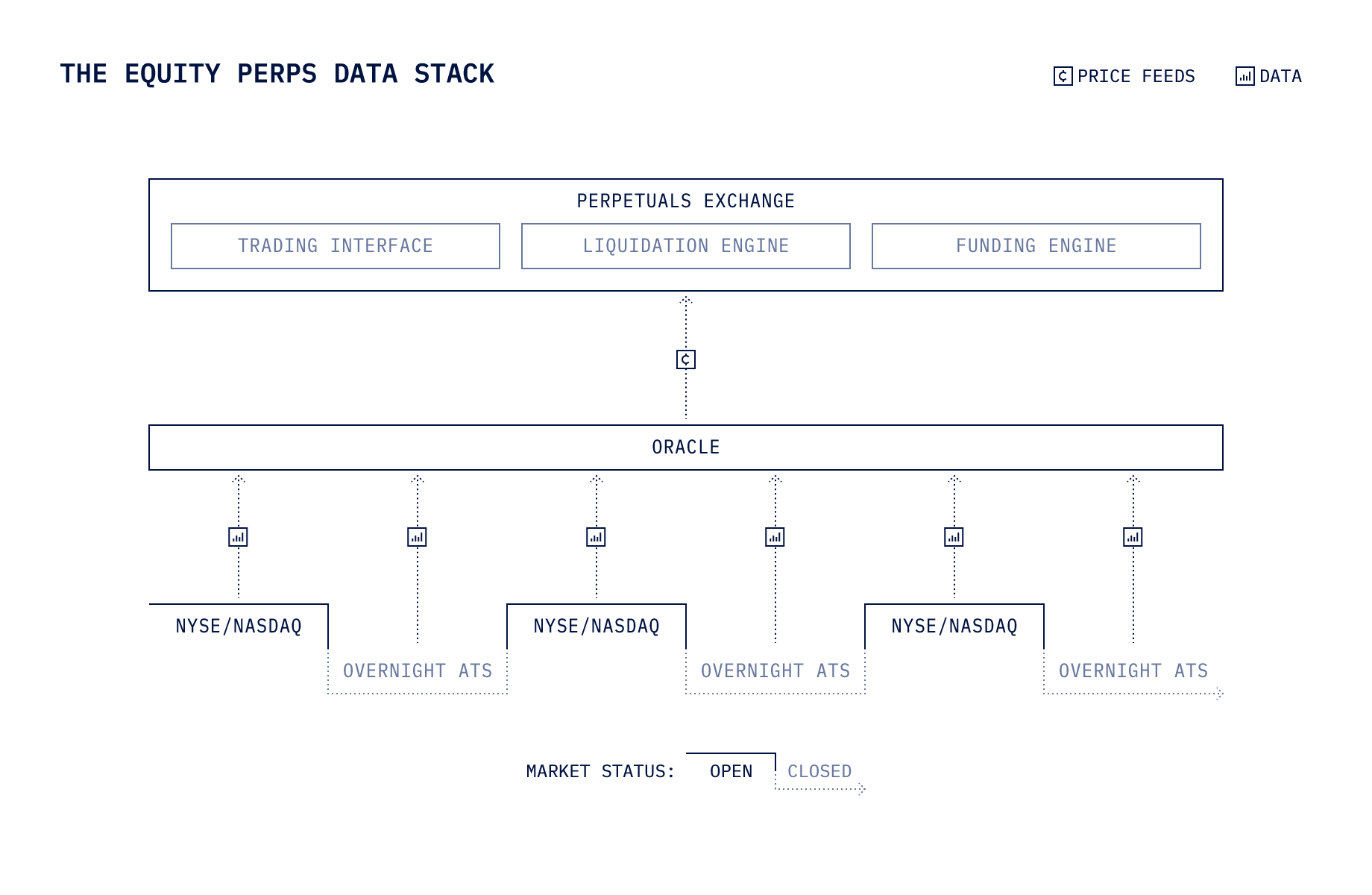
Trading a stock when the market is closed requires a reliable source of truth. If the Nasdaq is dark, how do we know what a share of Apple should be worth? This is where market data providers, aka oracles, like Stork come in.
Stork is an ultra-low-latency oracle designed specifically for the high-stakes world of perp DEXs. Stork revolutionized first-generation oracles, built for slower lending protocols, developing reliable price feeds that meet the frequency and latency requirements of onchain perpetuals futures markets. On any given day at this writing, Stork powers more than half the total volume in onchain perpetuals, serving six or seven of the top 10 perp DEXs. Beyond perpetuals, Stork is broadly useful as a DeFi oracle, as shown recently in a collaboration with Arc blockchain that supported ETHGlobal hackathon projects.
Stork makes its market-leading equity perps feeds available by aggregating data from a variety of sources and offers feeds covering:
Stork’s battle-tested aggregation methods minimize counterparty risks such as manipulation, market ruction or chaotic liquidations during moments of extreme volatility.
While the benefits (and possibly inevitability) of equity perps are becoming clear, the risks associated with equity perps are distinct from those in both the traditional equities futures market and the more recently established crypto-native perps markets. Traders must be aware that while they can link to a general discussion of perps trading risks (like liquidation and funding volatility), the "equity" component adds several layers of complexity.
In the traditional US equity market, liquidity is concentrated in two major hubs. With equity perps, liquidity is fragmented across various onchain (“decentralized”) and offchain (“centralized”) exchanges. It’s quite different from the world of US equities, in which major companies’ stocks are listed on one of two venues (Nasdaq or NYSE), where the lion’s share of liquidity is concentrated.
Equity perps rely on off-hours venues like Blue Ocean ATS to determine their price when the main exchanges are closed. In August 2024, for example, the biggest overnight stock venue suspended trading and canceled trades during a volume spike driven by traders in East Asia. Market infrastructure has improved since then, but this remains uncharted territory.
For an equity perp trader, this creates a doubled layer of counterparty risk: not only could your derivatives trading venue have an issue, but its price feeds depend on trading in innovative markets that are by nature untested. This is truly the “bleeding edge.”
The most dangerous moments for equity perps occur during market status transitions, the minutes surrounding the 9:30 AM ET open and the 4:00 PM ET close. At these times, the oracle price powering an equity perps trade must transition from thin, overnight price discovery to the massive volume of the primary exchange. Without carefully architected data infrastructure, this can make exchanges vulnerable to manipulation and increase traders’ gap risk. To minimize these risks, Stork:
The rise of equity perps signals a breakthrough moment in financial markets, offering a level of flexibility and global access that was previously impossible. However, the intersection of 24/7 crypto technology and legacy equity markets is a high-friction zone.
For the modern trader, the strategy is simple: leverage the tool, but respect the plumbing. Ensure you are trading on venues supported by high-fidelity oracles like Stork, maintain a conservative margin buffer to survive overnight volatility gaps, and always keep one eye on the health of the underlying ATS venues.
To learn more about Stork's equity feeds for perps markets and other use cases, get in touch with us.