The term “blockchain oracle” has the ring of fantasy or science fiction, a vibe that comes straight out of its origins in Ethereum’s dreamy, early days. The function of oracles today in onchain finance is more solid, and easily understood by financial professionals.
In traditional finance, the integrity of every derivative, structured product, and lending facility depends on reference data. The S&P 500, for example, functions as a shared source of truth that enables an entire ecosystem of options, futures, ETFs, and structured products.
In onchain finance, the blockchain oracle is this shared source of truth: a mechanism by which data from external sources is verified and made available for consumption in a smart contract environment.
Blockchains are closed systems. A smart contract can only execute based on information that exists within the chain itself, e.g., does this transaction have a verified signature; does this account hold necessary funds. The blockchain itself has no native ability to access external data like prices, interest rates, or election outcomes.
Oracles solve this constraint by sourcing, verifying, and delivering external data to smart contracts. An oracle may deliver a price feed that aggregates data from multiple external sources, applies calculation or outlier rejection, and publishes a reference price that smart contracts can read and act on. Smart contract actions might include liquidating collateral to satisfy a margin call, or settling a position on a derivatives contract.
A blockchain can verify internal transactions with a high degree of certainty, but it cannot independently verify whether the data fed into it is accurate. The oracle introduces a trust surface that the blockchain itself cannot secure. This makes oracle design choices consequential.
Check out related research from Stork Labs, outlining a framework for analyzing blockchain oracle risk and composability.
Not all oracles are equivalent. Evaluating oracle infrastructure across four dimensions helps clarify what the tradeoffs actually are.
The conventional framing of an oracle as a link from the real world into a blockchain understates the role it plays in onchain finance today. Onchain protocols increasingly depend not just on external data, but on each other. Lending protocols and perp DEXs consume spot prices. Yield vaults consume both prices and lending rates. The oracle is the trusted data source that enables “composability,” allowing, for example, a token issued in one environment to be used as collateral for a loan in another.
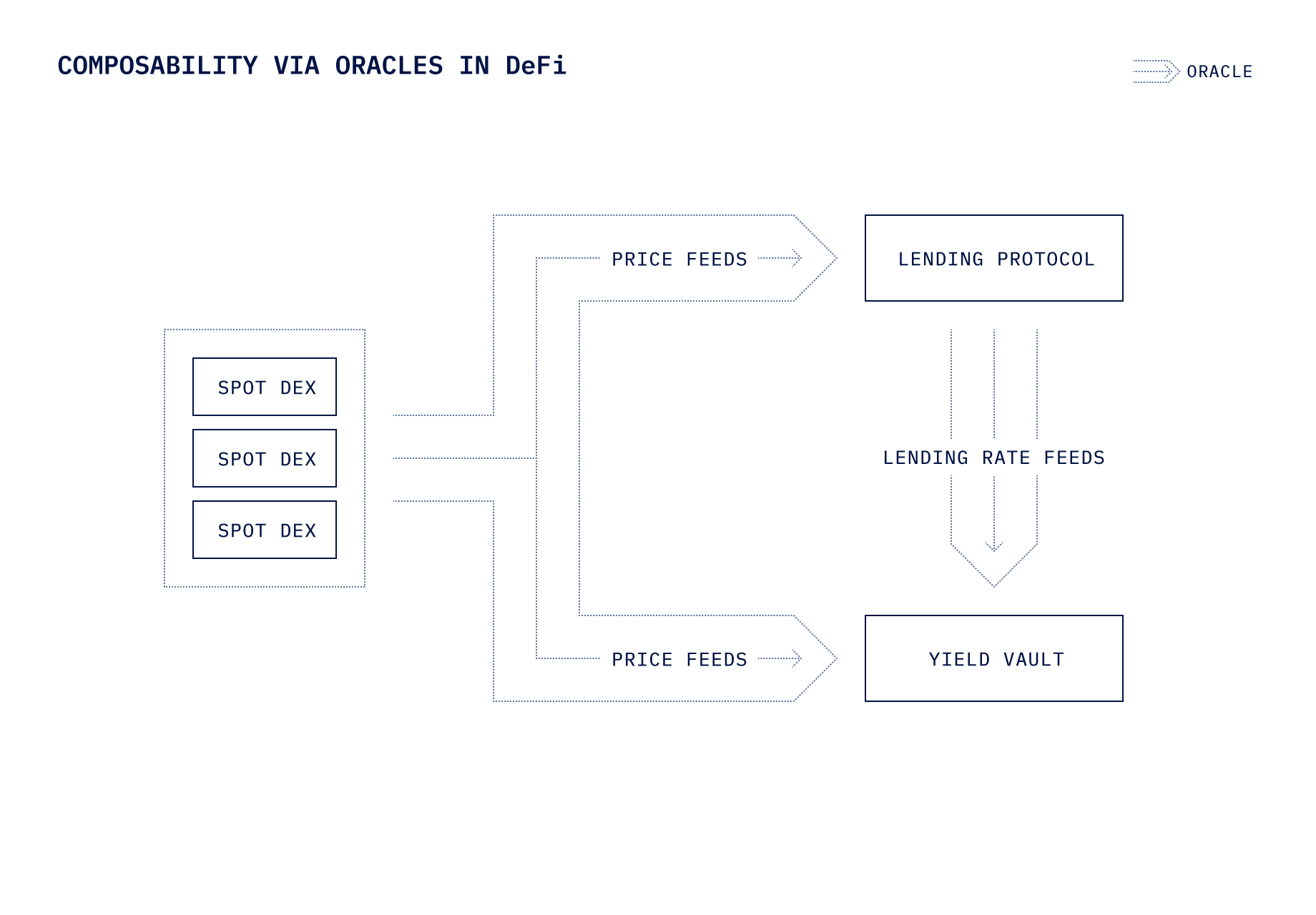
This is structurally similar to how reference data infrastructure functions in traditional finance. For example, SOFR feeds into structured notes, which are held in portfolio products. In onchain finance, this kind of composability can be highly dynamic, with settlement that is cryptographically guaranteed and visible to all.
Oracles function as the data connector facilitating this dynamic composability. Accuracy and uptime are therefore systemic concerns, not just concerns for individual protocols. The quality of the oracle impacts the reliability and product range of everything plugging into it.
Lending protocols use price feeds to determine collateral values, loan-to-value ratios, and liquidation thresholds. The structure is directly analogous to how margin lending desks mark positions in traditional finance. The latest innovation in this area involves the use of real-world assets (RWAs) as collateral in DeFi lending protocols. This is sometimes called “RWAfi,” and requires RWA oracle price feeds.
The critical dimensions for lending are accuracy and uptime. Latency requirements are less acute than in trading contexts, since lending positions turn over more slowly. But when data failures occur, the consequences are severe and often irreversible within a given block window. If the reference price is wrong or stale, under-collateralized positions persist until they cannot be sustained, at which point forced liquidations and bad debt socialize losses across all lenders.
Perpetual futures exchanges mark open positions against a continuous oracle price. The relationship between the oracle price and the market price drives funding rates, margin calculations, and liquidations. When the two prices diverge, even briefly, the gap creates exploitable conditions that impose costs on liquidity providers and users.
Latency is the critical variable in this environment. Sub-second lag is sufficient to create arbitrage opportunities that programmatic actors can exploit. This requirement drove the development of ultra-low-latency price feed architecture in newer oracle providers. Stork was built specifically to serve this environment and now provides oracle infrastructure for a significant portion of decentralized perpetuals volume.
The emerging world of RWA perps has created new challenges in this area as oracles must deliver low latency, high accuracy and near-perfect uptime across periods of market transition.
The tokenization of equities, government securities, foreign exchange instruments, credit products, and commodities represents a significant expansion of what onchain protocols need from oracle infrastructure. These assets require price feeds that extend well beyond the native crypto asset universe, including equity prices, benchmark rates, yield curves, and foreign exchange fixings.
Speed of asset coverage matters. Institutional product cycles do not accommodate multi-week delays for an oracle provider to list a new asset class. The ability to support novel asset types from launch, what Stork describes as Day 1 asset coverage, is a meaningful practical constraint on how quickly RWA protocols can bring new products to market.
SEC Chair Paul Atkins noted in a May 2025 keynote address that tokenization can enhance capital formation by transforming relatively illiquid assets into liquid investment opportunities. If that transformation is to happen at scale, the oracle infrastructure underlying it needs to be able to move at the same pace.
The first generation of oracle infrastructure solved the foundational problem of getting external data onchain. It did so reliably, but with performance characteristics suited to the DeFi applications of that era, primarily lending.
The current generation is designed to meet more stringent demands, including perpetuals exchanges that demand low latency feeds, RWA integrations that demand creative pricing solutions and market coverage, and an increased emphasis on uptime as institutions enter the world of onchain finance.
Stork's architecture reflects this: the system was built first for the most demanding performance environment (a perp DEX oracle), then extended across a broader range of financial applications without compromising the latency characteristics that defined its initial design. Stork’s uptime and accuracy are unrivaled. The ability to quickly support new assets, blockchains and even whole asset categories is built into the Stork oracle infrastructure.
In traditional finance, no serious financial product gets built without a clear answer to the data question. Onchain finance is arriving at the same point of maturity. The oracle is increasingly a strategic infrastructure choice. Accuracy, uptime, coverage, and latency compound over time into a protocol's reliability and the range of products it can support.
As the onchain financial stack grows more complex and more composable, the quality of the shared data becomes proportionally more consequential. That is not a property unique to blockchain systems; it is how layered financial infrastructure has always worked.
Get in touch with us to learn more: stork.network/contact.